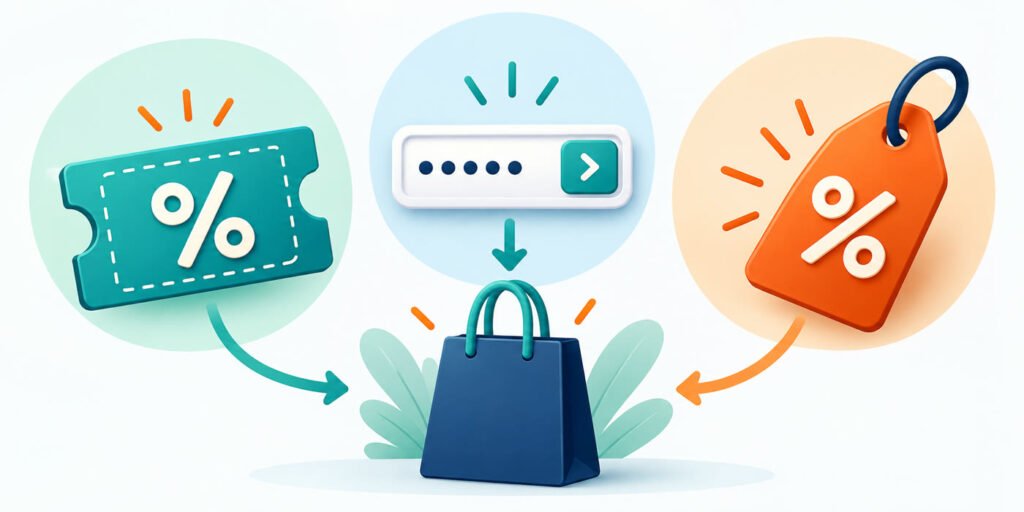
Sometimes a merchant coupon and a bank offer can be used in the same order, but stacking is never automatic. It depends on the retailer’s checkout rules, the coupon terms, the card or payment promotion, the eligible products and the transaction type. The only reliable test is the final order summary before payment.
What does “stacking” offers mean?
Stacking means receiving more than one promotional benefit on the same purchase. A common example is an item already at a sale price, plus a merchant coupon, plus an eligible card discount. Another order may allow only the sale price and bank offer, or require the shopper to choose one coupon.
The words “additional” or “instant discount” do not by themselves guarantee compatibility. Read each promotion’s exclusions and combination rules.
Combinations that may be possible
Automatic sale price plus a bank offer
A product’s displayed sale price may remain in the cart when an eligible payment method is selected. However, the bank promotion can still exclude certain products, sellers, card types, EMI transactions or already-discounted items.
Merchant coupon plus a bank or card promotion
A code can sometimes reduce the eligible subtotal first, after which the bank offer is calculated. This can create an important issue: the coupon may push the payable amount below the bank offer’s minimum spend. In other checkouts, the bank threshold may use a different transaction value. Confirm the calculation shown by the retailer.
Coupon plus cashback
Later cashback may coexist with a merchant discount, but only when both sets of terms permit it. Confirm the qualifying payment route, settlement period, cancellation rules and where the cashback will be credited.
Why two offers may not combine
- One-coupon limit: the checkout accepts only one manual code.
- Minimum spend: another discount reduces the qualifying amount.
- Card eligibility: the offer is limited to a bank, card network, card variant or customer segment.
- EMI conditions: only selected tenures, issuers or EMI types qualify.
- Product or seller exclusions: a model, seller, category, gift card or service is not eligible.
- Transaction exclusions: wallet loads, corporate cards, international cards, cash-on-delivery or other routes may be excluded.
- Promotion conflict: the merchant explicitly prevents combining the coupon with another offer.
- Benefit cap: the maximum discount has already been reached.
How to check before paying
- Add the exact product, seller, variant and quantity you intend to buy.
- Note the sale price and eligible subtotal.
- Apply the merchant code and read the response.
- Select the intended card, bank, wallet or EMI option.
- Check whether both benefits remain in the order summary.
- Review fees, interest, taxes, delivery charges and cashback timing.
- Compare the final payable amount—not just the headline percentages.
If the code disappears after selecting payment, revisit the terms instead of repeatedly placing orders. The guide to coupon-code failures provides a broader troubleshooting checklist.
Card and EMI details that matter
Check whether the promotion requires a credit card, debit card or a specific network. Co-branded, commercial, add-on and international cards may be treated differently. For EMI, review the eligible tenure, minimum transaction, processing fee, interest and whether the promotion applies to standard EMI, no-cost EMI or both.
A no-cost EMI label does not mean every charge disappears. Compare the total repayment and any processing cost shown by the issuer or checkout.
Examples from electronics shopping
Electronics checkouts often combine several price components: a sale price, exchange value, coupon, bank promotion and EMI choice. The Amazon, Flipkart and Croma guides explain the merchant-specific conditions worth checking without claiming that a particular bank offer is live.
For purchase timing, model comparison and exchange evaluation, read Best Time to Buy Electronics in India or browse the Electronics & Appliances category.
The practical rule
Assume nothing stacks until the live checkout shows both benefits and the terms allow the combination. Keep the order summary, understand whether each benefit is immediate or delayed, and avoid increasing the cart only to chase a promotion that does not improve the final value.
Offer availability and payment conditions can change. Review our verification policy and use the contact page to report an issue.